
The SDGs aren’t just a buzzword at Quest International University (QIU) – they are a way of life. We pride ourselves on being a progressive, socially responsible institution of higher learning committed to uplifting the community and supporting all initiatives that help rehabilitate our planet from the effects of adverse climate change.
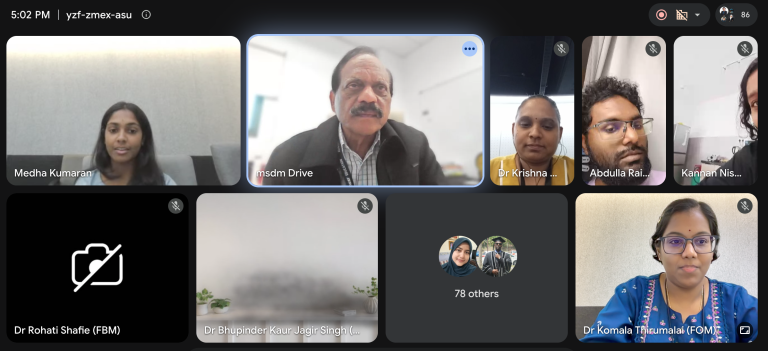
Our latest expert-led talk endorses this ideal. Building on the success of the Nutrition and Healthy Eating Workshop, our SDG Steering Committee recently organised an enlightening webinar on waste management for the QIU community. The talk was led by Professor Dato’ Dr Agamuthu A/L Pariatamby – a renowned authority on the subject affiliated with the Jeffrey Sachs Center on Sustainable Development at Sunway University.
While the scope of the webinar covered many SDGs, it was most relevant to #12 – Responsible Consumption and Production.
This webinar was well-timed not only because climate change action routinely makes the headlines, most recently with the ‘Super El Niño’ weather phenomenon set to raise global temperatures in 2027, but also because Malaysia’s landfill problem is worsening. SWCorp projects that national landfills will be full by 2041 unless the annual increase in waste triggers a proportional uptick in recycling, repurposing, and reuse.
Professor Dato’ Dr Agamuthu’s talk offered eye-opening insights into the scale of the problem. Contrary to common misconceptions, he said, waste management challenges cannot be solved with generic technology or by focusing solely on commercial sectors. Furthermore, while developed nations like the US and Canada lead the world in per capita waste generation, developing nations suffer disproportionately because waste management receives low priority in national budgets.
Speaking about food waste, he said it is driven predominantly by households, which generate 60% of such waste and contribute 8–10% of global greenhouse gas emissions. The really sobering statistic is that people waste over 1 billion meals daily, while food insecurity affects twice that number.
Moreover, severe infrastructural deficits, such as recycling systems not keeping pace with technological consumption, compound the crisis. For context, out of 62 million tonnes of e-waste produced globally in 2022, only 22.3% was formally recycled, he said.
A lively Q&A session followed Professor Dato’ Dr Agamuthu’s presentation. Fielding a question about waste separation, he clarified that implementation varies across Malaysia because not all states have adopted the national Solid Waste Bill. Penang, for instance, operates independently of the bill yet achieves the country’s highest recycling rate through effective local initiatives. When asked about the best way to manage food waste, he identified anaerobic digestion, as practised in Japan, as the most effective approach.
We’re indebted to Professor Dato’ Dr Agamuthu for taking the time to educate the QIU community about this pressing issue. He couldn’t have enlightened a more dialled-in crowd. Whether tackling food insecurity, inequality in education, or our carbon footprint, QIU staff and students are always in the proverbial trenches to support local and nationwide efforts to leave a better planet for future generations. Kudos all around!

