
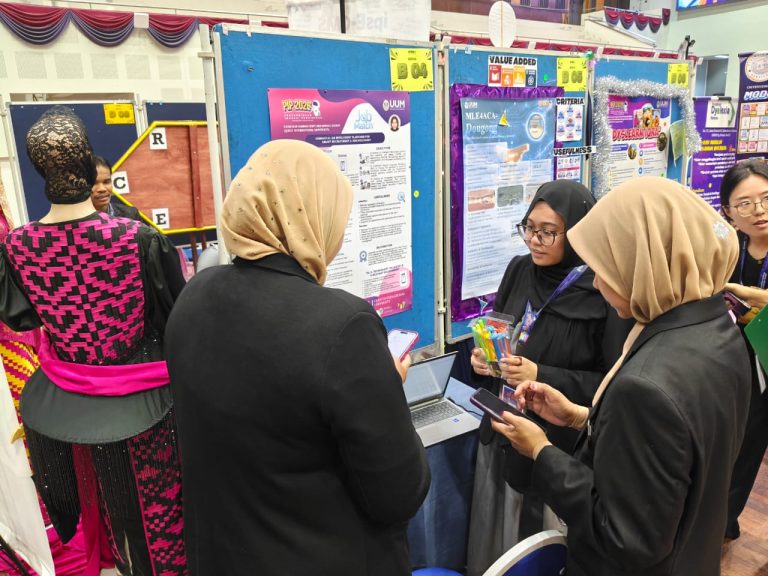
Bachelor of Information Technology (Hons) student Fatin Nur Hannah binti Muhammad Ashraf has joined the ranks of our student success stories, after she won a Silver Award at the 8th National Innovation Education Competition, or Pertandingan Inovasi Pendidikan Peringkat Kebangsaan (PIP 2026).
The competition was organised by the University Teaching and Learning Centre (UTLC), Universiti Utara Malaysia (UUM), and held from 28 to 30 September 2026 at Mu’adzam Shah Hall, UUM, Sintok, Kedah.
Fatin competed in Category B, which is open to students from public and private higher education institutions, institutes of teacher education, polytechnics and community colleges. Other participants included Sunway University, Universiti Utara Malaysia (UUM), Universiti Kebangsaan Malaysia (UKM), Universiti Malaysia Terengganu (UMT), Universiti Pendidikan Sultan Idris (UPSI), and Universiti Sains Malaysia (USM).
Her project, “JobMatch: An Intelligent Platform for Smart Recruitment and Job Discovery”, was developed as her Final Year Project. It tackles two problems that are common in the job market. Job seekers, especially students and fresh graduates, often find it hard to locate vacancies that truly match their skills and qualifications. Recruiters, on the other hand, spend a great deal of time manually screening large numbers of applications.
JobMatch brings both groups together on one mobile-first platform. It uses semantic Natural Language Processing (NLP) to match candidate profiles with job requirements based on meaning rather than exact keywords. Optical Character Recognition (OCR) turns uploaded resumes and certificates into structured profile data, which users can review and correct. An AI-assisted ranking feature helps recruiters focus on suitable applicants, while job seekers receive personalised job recommendations. The platform supports matching in both Bahasa Melayu and English, and it is designed so that final recruitment decisions remain with people rather than the system.
Fatin has developed a working prototype that integrates the core job seeker and recruiter workflows and has tested it using realistic recruitment scenarios. The project also shows clear commercialisation potential. It offers small and medium enterprises (SMEs) access to AI-assisted recruitment without the need for complex HR systems, and it can scale from local recruitment to the wider Malaysian employment market.
During the judging sessions on 29 and 30 September, Fatin presented a live demonstration of JobMatch to the panel of judges and to visitors, who were able to download and try the app by scanning a QR code at her booth.
“I am both grateful and overwhelmed by all the recognition I have received. JobMatch was developed from my own experience of struggling to find job opportunities that truly matched my skills and preferences, and I realised that many fresh graduates face similar challenges. The hope is that, with further development and improvements, JobMatch can help job seekers and employers, particularly SMEs, find the right match more efficiently and quickly, in line with the objectives of the project,” said Fatin.
Most importantly, I am truly grateful for all the guidance, encouragement, and support I have received from my supervisor, lecturers, the Faculty, and QIU throughout this journey.”
PIP 2026 brings together scholars, educators, researchers, innovators and students from education institutions across Malaysia to showcase their research and innovation and to share best practices in teaching and learning.
JobMatch supports SDG 8 (Decent Work and Economic Growth) by helping fresh graduates find jobs that match their skills and by giving SMEs affordable access to AI-assisted hiring. It contributes to SDG 9 (Industry, Innovation and Infrastructure) by bringing NLP and OCR technology to small businesses that lack complex HR systems, and to SDG 10 (Reduced Inequalities) by supporting matching in both Bahasa Melayu and English and keeping final hiring decisions with people rather than the system. As a Final Year Project that turned classroom learning into a working product, it also reflects SDG 4 (Quality Education).
The Faculty of Computing and Engineering congratulates Fatin on this achievement. Her success reflects the Faculty’s commitment to project-based, industry-relevant learning that prepares graduates for the workforce and encourages innovation with social impact.

