
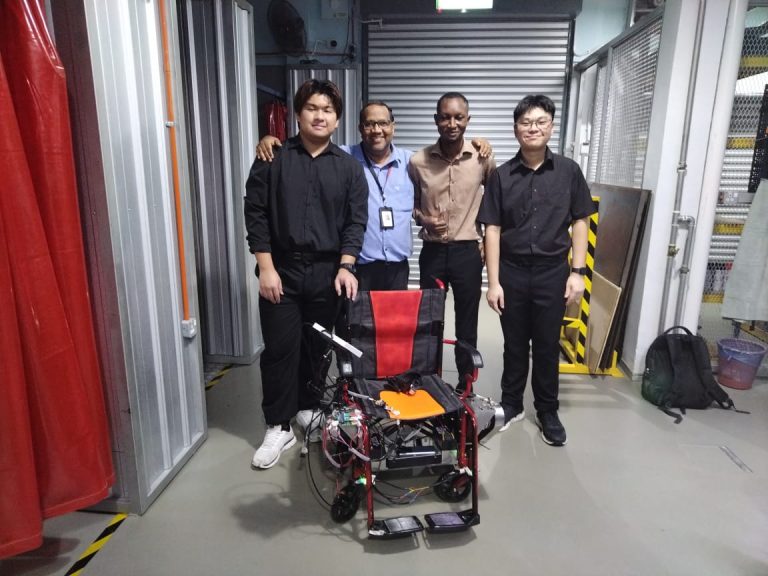
For people living with mobility limitations, greater independence can make a meaningful difference in everyday life. Three of our Engineering students are putting engineering and technology to work towards that goal, winning a silver award for an innovative wheelchair control system at the International Innovation Competition (INNOCOM VII 2026).
Chen Kah Kit, Wong Wei Meng and Twaliq Halid Magenda, from the School of Engineering under QIU’s Faculty of Computing and Engineering (FCE), won recognition for their project, “Multi Modal Smart Wheelchair Control System Using Raspberry Pi 5”, at the competition.
The competition brought together 102 participants from Malaysia, Indonesia, Brunei, Pakistan and Thailand, providing a platform for students, researchers and academics to showcase their work, exchange ideas and learn from innovations across different fields. Participating institutions included Universiti Teknologi PETRONAS (UTP), Universiti Malaysia Sabah (UMS), Universiti Teknologi MARA (UiTM), Universiti Sains Islam Malaysia (USIM) and Universitas Negeri Surabaya (UNESA), among others.
Their award marked QIU’s second batch of accolades at INNOCOM VII, after PhD in Science student Sarannia Thanganathan won two awards for her poster presentation on biodegradable polymer technology and plant-derived bioactive compounds.
Supervised and coordinated by Mr Chelladurai Sinkaram and Mr Anas Hambali, the smart wheelchair project explores how Raspberry Pi 5 technology can be integrated into a multimodal wheelchair control system to make mobility more accessible and user-friendly.
Beyond its technical aspects, the project reflects a simple but important idea: innovation matters most when it addresses real human needs. By exploring smarter ways to control a wheelchair, the students are applying their engineering and computing knowledge to a challenge that affects people’s independence, accessibility and quality of life.
Their achievement at INNOCOM VII 2026 highlights the potential of student-led innovation to go beyond the classroom, demonstrating how ideas developed through academic learning can contribute to solutions with meaningful social value.
For the QIU students, the experience offered an opportunity to put their ideas before a wider audience, learn from other innovators and explore how engineering principles can be translated into practical applications. It also strengthened their problem-solving, critical-thinking and presentation skills, while reinforcing the importance of designing technologies around the needs of the people who may use them.
At QIU, innovation is about more than developing new technologies or earning accolades. It is about equipping students with the knowledge, creativity and confidence to identify challenges and explore solutions that can improve lives.
Through hands-on learning and practical project development, the university encourages students to connect what they learn in the classroom with the needs of the wider community. Projects such as the smart wheelchair control system reflect this approach, bringing together technical knowledge and a sense of social responsibility.
QIU congratulates Chen Kah Kit, Wong Wei Meng and Twaliq Halid Magenda, together with their supervisors, on their achievement at INNOCOM VII 2026. Their work reflects the promise of young innovators who are not only looking to advance technology, but also to make it more meaningful, accessible and beneficial to society.

