
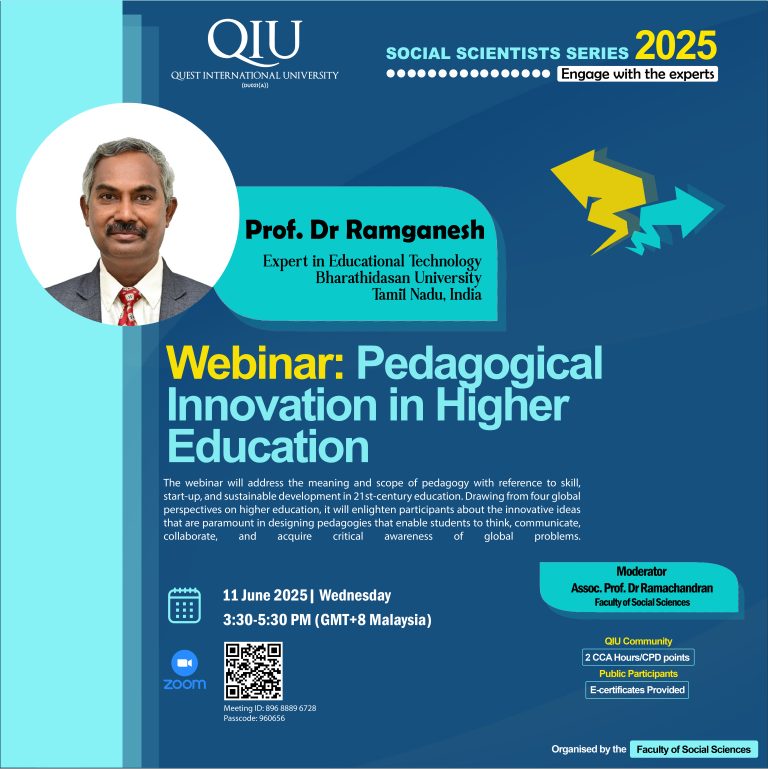
QIU Webinar Explores Pedagogical Innovations in Higher Education

In a compelling effort to spotlight the evolving landscape of education, our Faculty of Social Sciences’ School of Postgraduate Studies recently hosted an enlightening webinar titled “Pedagogical Innovations in Higher Education”. The virtual session brought together participants, comprising academics, researchers, and university students from diverse disciplines, reflecting the growing interest in reshaping teaching and learning for the 21st century.

The session was officially inaugurated by QIU Vice-Chancellor Professor Zita Mohd Fahmi, who emphasized the university’s commitment to fostering academic excellence through innovative educational practices. 

The keynote address was delivered by Professor Dr. Ramganesh, a distinguished expert in Educational Technology from Bharathidasan University, Tamil Nadu, India. His presentation offered a thought-provoking exploration of pedagogy’s evolving role in the 21st century, highlighting the interconnectedness of skill development, entrepreneurship, and sustainable education. 

Drawing from four global frameworks in higher education, the webinar highlighted the importance of innovative teaching strategies that foster critical thinking, effective communication, meaningful collaboration, and global engagement. The discussions reinforced the need for flexible, forward-looking educational models that equip students with the competencies required to succeed in an increasingly interconnected world.

The demand for quality education has never been more critical in the 21st century. As global challenges and technological advancements reshape industries, education systems must evolve to equip students with essential skills. 

Pedagogical innovations—such as flipped classrooms, blended learning, competency-based education, and inquiry-driven learning—enhance engagement and prepare learners for the complexities of Industry 4.0. 

Higher education institutions play a transformative role beyond academic instruction. They serve as centers for social innovation, economic progress, and lifelong learning. To ensure graduates are workforce-ready, universities must prioritise qualification-based learning, interdisciplinary integration, and holistic education. Emerging university models, including skill-focused, networked, and personalised learning institutions, reflect this shift.

Fusion education integrates disciplines, technologies, and pedagogies, fostering critical thinking, creativity, and digital fluency. Teachers must design learning environments that cater to diverse student needs, incorporating frameworks that develop intellectual and emotional intelligence. 

As higher education transitions to flexible, learner-centred models, embracing pedagogical innovation is key to fostering adaptability and problem-solving skills. Institutional support, faculty development, and inclusivity are essential in implementing these reforms effectively, ensuring students acquire the competencies needed to thrive in an evolving global landscape.

The discussions pointed to a clear imperative: universities must create inclusive, adaptive learning environments that support both intellectual and emotional growth. Institutional support, faculty development, and a commitment to inclusivity are vital to the successful implementation of pedagogical reforms.

As the higher education sector continues its transformation, initiatives like QIU’s webinar serve as valuable platforms for collaboration, reflection, and progress. By embracing pedagogical innovation, universities can empower learners to navigate and contribute meaningfully to an increasingly interconnected and fast-changing global society.

Facebook
Twitter
LinkedIn

SEARCH...

Menu

Scan WeChat QR Code

Week StartWeek EndAcademic WeekActivityRemarksPublic Holidays
11-AprRegistration(new students only)
13-Apr17-AprOrientation(new students only)
20-Apr24-AprWeek 1Learning Week
27-Apr1-MayWeek 2Learning WeekLabour Day1-MayFri
4-May8-MayWeek 3Learning Week
11-May15-MayWeek 4Learning Week
18-May22-MayWeek 5Learning Week
25-May29-MayWeek 6Learning WeekHari Raya Aidiladha27-MayWed
Wesak Day31-MaySun
1-Jun5-JunWeek 7Learning WeekAgong’s Birthday1-JunMon
(RPH) Wesak Day1-JunMon
8-Jun12-JunWeek 8Self-Study Week
15-Jun19-JunWeek 9Final ExaminationAwal Muharram17-JunWed
22-Jun26-JunSemester Break
29-Jun3-JulSemester Break
Week StartWeek EndAcademic WeekActivityRemarksPublic Holidays

27-Jun

Sat

  Registration(new students only)  

29-Jun

Mon

3-Jul

Fri

 Orientation(new students only)  

6-Jul

Mon

10-Jul

Fri

Week 1Learning Week   

13-Jul

Mon

17-Jul

Fri

Week 2Learning Week   

20-Jul

Mon

24-Jul

Fri

Week 3Learning Week   

27-Jul

Mon

31-Jul

Fri

Week 4Learning Week   

3-Aug

Mon

7-Aug

Fri

Week 5Learning Week   

10-Aug

Mon

14-Aug

Fri

Week 6Learning Week   

17-Aug

Mon

21-Aug

Fri

Week 7Learning Week   

24-Aug

Mon

28-Aug

Fri

Week 8Learning Week Maulidur Rasul

25-Aug

Tue

31-Aug

Mon

4-Sep

Fri

Week 9Learning Week Merdeka Day

31-Aug

Mon

7-Sep

Mon

11-Sep

Fri

Week 10Learning Week   

14-Sep

Mon

18-Sep

Fri

Week 11Learning Week Malaysia Day

16-Sep

Wed

21-Sep

Mon

25-Sep

Fri

Week 12Learning Week   

28-Sep

Mon

2-Oct

Fri

Week 13Learning Week   

5-Oct

Mon

9-Oct

Fri

Week 14Learning Week   

12-Oct

Mon

16-Oct

Fri

Week 15Self-Study Week   

19-Oct

Mon

23-Oct

Fri

Week 16Final Examination   

26-Oct

Mon

30-Oct

Fri

Week 17Final Examination   

2-Nov

Mon

6-Nov

Fri

 Semester Break Sultan of Perak’s Birthday

6-Nov

Fri

 Deepavali

8-Nov

Sun

9-Nov

Mon

13-Nov

Fri

Semester Break Deepavali

9-Nov

Mon

16-Nov

Mon

20-Nov

Fri

Semester Break Convocation

21-Nov

Sat

  1. The University reserves the right to amend as and when required
  2. When a public holiday falls on Sunday, the holiday is substituted with the following working Monday/working day
  3. 21 November 2026 – Convocation
  4. The University Management has decided to grant extra leave for certain festivals that fall at the beginning or end of the week. Therefore, replacement classes must be conducted on the dates
    provided by the Registrar’s Office
Week StartWeek EndAcademic WeekActivityRemarksPublic Holidays

24-Oct

Sat

  Registration(new students only)  

26-Oct

Mon

30-Oct

Fri

 Orientation(new students only)  
2-Nov
Mon
6-Nov
Fri
 PNP Week 1(new students only)Sultan of Perak’s Birthday

6-Nov

Fri

Deepavali

8-Nov

Sun

9-Nov

Mon

13-Nov

Fri

 Deepavali Break Deepavali

9-Nov

Mon

16-Nov

Mon

20-Nov

Fri

 PNP Week 2(new students only)  

23-Nov

Mon

27-Nov

Fri

Week 1Learning Week   

30-Nov

Mon

4-Dec

Fri

Week 2Learning Week   

7-Dec

Mon

11-Dec

Fri

Week 3Learning Week   

14-Dec

Mon

18-Dec

Fri

Week 4Learning Week   

21-Dec

Mon

25-Dec

Fri

Week 5Learning Week Christmas Day

25-Dec

Fri

28-Dec

Mon

1-Jan

Fri

Week 6Learning Week New Year’s Day

1-Jan

Fri

4-Jan

Mon

8-Jan

Fri

Week 7Learning Week   

11-Jan

Mon

15-Jan

Fri

Week 8Learning Week   

18-Jan

Mon

22-Jan

Fri

Week 9Learning Week Thaipusam

22-Jan

Fri

25-Jan

Mon

29-Jan

Fri

Week 10Learning Week   

1-Feb

Mon

5-Feb

Fri

Week 11Learning Week Chinese New Year

6-Feb

Sat

 Chinese New Year

7-Feb

Sun

8-Feb

Mon

12-Feb

Fri

 Mid-Semester Break Chinese New Year

8-Feb

Mon

15-Feb

Mon

19-Feb

Fri

Week 12Learning Week   

22-Feb

Mon

26-Feb

Fri

Week 13Learning Week Nuzul Al-Quran

24-Feb

Wed

1-Mar

Mon

5-Mar

Fri

Week 14Learning Week   

8-Mar

Mon

12-Mar

Fri

Week 15Self Study Week Hari Raya Aidilfitri

10-Mar

Wed

 Hari Raya Aidilfitri

11-Mar

Thu

15-Mar

Mon

19-Mar

Fri

Week 16Final Examination   

22-Mar

Mon

26-Mar

Fri

Week 17Final Examination   

29-Mar

Mon

2-Apr

Fri

 Semester Break   

5-Apr

Mon

9-Apr

Fri

Semester Break   

(PNP : Pre-November Programme)

  1. The University reserves the right to amend as and when required
  2. When a public holiday falls on Sunday, the holiday is substituted with the following working Monday/working day
  3. The University Management has decided to grant extra leave for certain festivals that fall at the beginning or end of the week. Therefore, replacement classes must be conducted on the dates
    provided by the Registrar’s Office