
This article was originally published on the Times Higher Education website on May 18, 2025. It has been reproduced with permission from the original writer and publication. The original article can be found here.
By John Ross
When a professor on a lecture tour complains of exhaustion, his driver – who’s heard the presentation so often he knows it by heart, including the inevitable questions and their answers – offers to stand in for him. The two exchange outfits and the professor dozes at the back of the hall while the driver plays sage on stage.
It goes without a hitch until the driver cops a question he’s never heard before. He doesn’t miss a beat. “That’s so easy,” he says, “I’ll let my chauffeur answer.”
It is an old joke. Variations involve a famous rabbi, American baseball manager Tommy Lasorda and Albert Einstein. And it is part of Vijay Mallan’s arsenal of yarns to help relax his students – all academic supervisors learning how to do the same for the doctoral candidates in their charge.
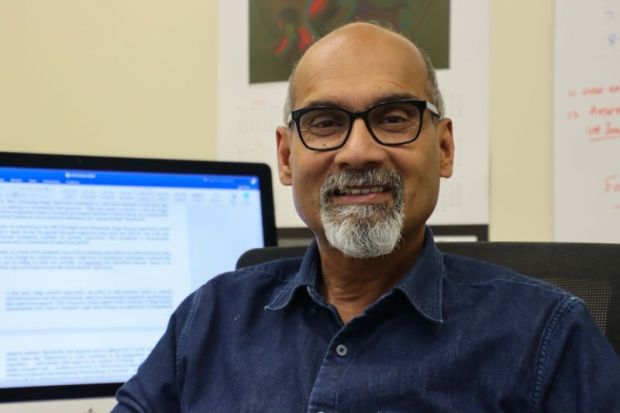
Vijay’s approach to supervision, which he describes as a “pedagogy of kindness”, uses humour to humanise the experience without diminishing academic rigour. It is an element of the Otago Doctoral Supervision Programme (ODSP) Vijay developed over four years at New Zealand’s University of Otago.
The programme encompasses 55 workshops across two streams – one for supervisors and one for research students – focusing on compliance, policy, pedagogy and human relations.
The team collaborated with cross-cultural supervision specialists to embed Māori and Pacific perspectives throughout the voluntary programme. Vijay says it has been adopted in various guises by some of the 45 universities where he has demonstrated the concept.
Now the ODSP has claimed an excellence award from the Australian Council of Graduate Research, which said the programme “stands out for its strong focus on mental health, sustainability and inclusive practice” and also for its research-informed input – all of it grounded in research conducted at Otago.
The ODSP frames doctoral supervision as a “professional partnership” where “reciprocal, reflective learning relationships” supplant “hierarchical, mentor-mentee models”, Vijay said. The benefits flow both ways. “I don’t meet my students assuming I’m the smartest person in the room. I want to learn from my students as well.”
That proved to be the case when Vijay supervised doctoral candidates investigating humour in postgraduate academic lectures and higher education more broadly. The projects fed into Vijay’s notion of a pedagogy of kindness, highlighting academics’ use of humour not just as “comic relief” but also to build trust, diffuse anxiety and enhance learning.
“Humour is my quiet rebellion against the stiffness of academic culture,” he said. “It is especially effective in cross-cultural contexts where formality can be intimidating.”
While some people are naturally funnier than others, Vijay says any supervisor can develop the skill with practice. But to work in an academic setting, humour must be both appropriate and relevant.
Relevance does not entail in-jokes only understood by disciplinary specialists, but jokes must be germane to the context. Conference presentation workshop participants often ask Vijay how to deal with audience questions they cannot answer. “Make use of your watch,” he says. “Say: ‘That’s a very interesting question, but I’m conscious of the time. Maybe we can talk about this over tea.’ Then when teatime comes, run away.”
It is a joke, of course. “It’s perfectly okay to tell them that you don’t know, and ask for help from people in the audience.” But some academics come from cultures where “admitting that you do not know is viewed negatively”, he said. Joking about the dilemma “diffuses tension”.
Jokes can also “backfire”, and that is where appropriateness comes in. Soon after joining Otago, Vijay – who hails from Malaysia – related a story during a student workshop. A group of women scream when a cockroach lands on their restaurant table until a male waiter arrives and holds out his hand, then walks away when the bug jumps on. The story was supposed to highlight the difference between proactivity and reactivity, but it earned scathing evaluations for gender bias. “That was a lesson for me,” he said. “After that, I was very careful not to mention gender.”
Vijay is now planning to adapt his programme for a different context, having begun a new post as dean of postgraduate studies at Quest International University in northern Malaysia.
He was drawn home partly by the opportunity to roll out the programme, but says cultural differences will not be the only challenge in a country where academics supervise as many as 10 doctoral students – well over the average of five or six revealed in a recent UK survey.
Reciprocal learning is “very rewarding” but “depends on the workload”, he concedes. The reflective model is an “aspirational” goal in Malaysia. “But when it works, it works very well.”
john.ross@timeshighereducation.com

