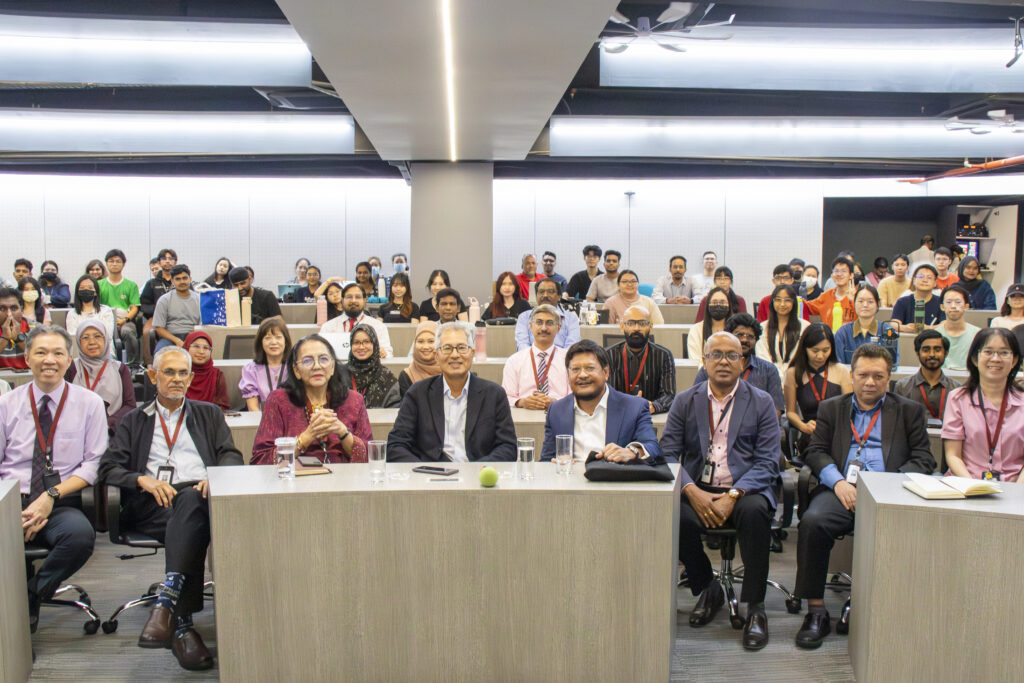
QIU welcomed senior banking and finance executive Mr Roni L. Abdulwahab for an insightful talk at The Curve, where he addressed QIU leaders, academics and students on the fast-evolving relationship between artificial intelligence, data and human judgement in business and finance.
Organised by QIU’s Faculty of Business and Management, the session drew a cross-section of the university community and industry guests. Mr Roni — whose leadership roles span banking, investment management, private equity and several corporate sectors across South-East Asia and India — framed the discussion around where algorithmic output ends and human judgement must begin.
Present at the talk were the QI Group Director for Corporate & Legal Affairs & Director for Education Mr Zaheer Merchant, QIU Vice-Chancellor Professor Zita Mohd Fahmi, QIU Chief Operating Officer Mr Nicholas Goh, QIU Registrar Mr Muhammad MG Omar, deans, academics, and students.
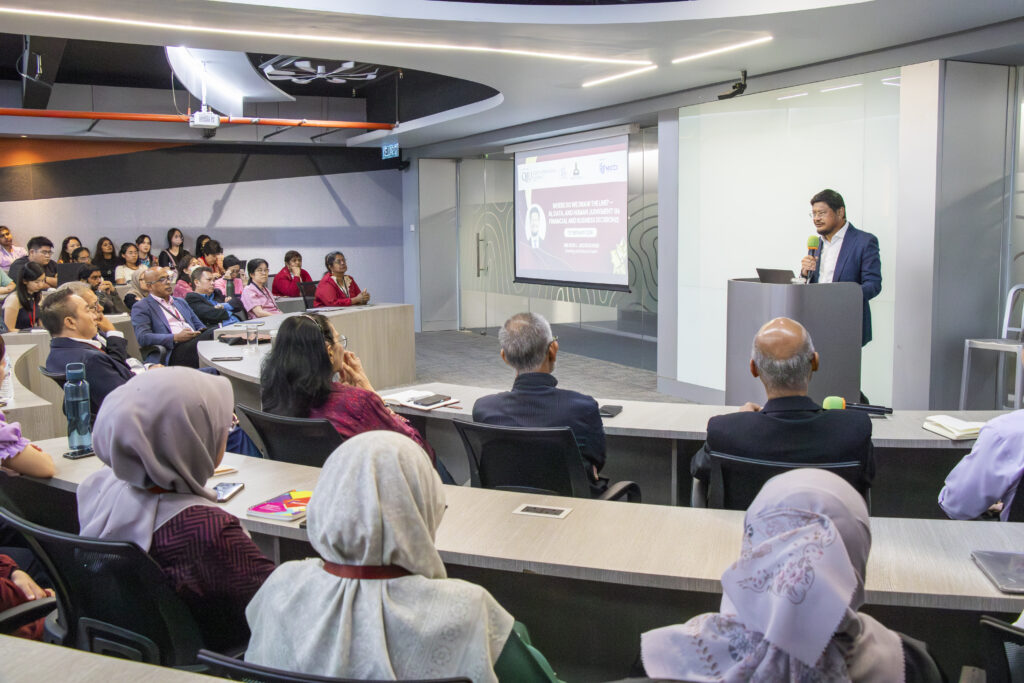
With a career that includes leading turnaround, transformation and change programmes as Group CEO of Bank Pembangunan Malaysia Berhad, Mr Roni brought both strategic and practical perspectives. He spoke about real-world trade-offs when organisations rely heavily on quantitative scores and data-driven models to make financial and business decisions.
A central theme of the talk was the human tendency to substitute judgement with numerical scores. Mr Roni highlighted that while data and AI dramatically improve speed and scale, they can promote overreliance on quantitative results at the expense of intuition and qualitative assessment. He also cautioned that current AI systems may struggle to detect aspects of character or unethical behaviour — qualities that remain critical in finance and corporate governance — although he acknowledged that some of these limitations may be reduced as technology evolves.
To help institutions navigate these challenges, Mr Roni proposed practical filters to guide decision-making frameworks. Important considerations he outlined included the criticality of the decision and the level of risk involved; whether accountability is clearly assigned; the capacity for a human override; and whether model outputs can be independently validated. These filters, he said, should determine how much weight organisations place on automated outputs versus human scrutiny.
The presentation was followed by a lively engagement session with students and industry representatives, giving attendees a chance to discuss application of the ideas in local and regional contexts, and to explore collaboration opportunities.


The event reiterates the university’s commitment to bridging academic learning with industry practice and preparing graduates to make informed, ethical decisions in an increasingly data-driven world. The Faculty plans to continue hosting forums that pair academic insight with practical leadership experience.