
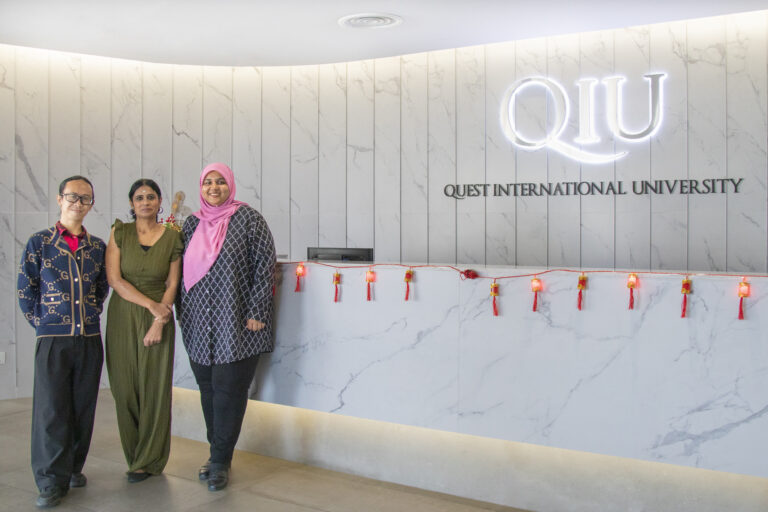
Three academics from Quest International University’s Faculty of Social Sciences — Associate Professor Dr Tilagavati Subramaniam, Mr Zulqarnain Abu Hassan, and Ms Nabillah Rafidah Binti Abdul Kadir — have earned top honours at the 6th Semarak International Research Article Competition (SIRAC 2026), taking home the Gold Award and the Best Article (Community Relevance) award.
Their paper, which examines social media use among Baby Boomers, was also selected for publication in a MYCITE-indexed journal.
The team’s research investigates how perceived usefulness and ease of use of social platforms can encourage compulsive behaviours among older users and increase their vulnerability to online scams. By focusing on real-world risks faced by local communities, the paper bridges academic theory with practical, community-level implications — a factor that helped it stand out for the Best Article (Community Relevance) prize. Their work highlights the need for targeted digital-literacy interventions and design considerations that protect older adults in rapidly evolving online environments.
“We feel this achievement reflects our lecturers’ research expertise in digital communication, social media behaviour,” said Mr Zulqarnain Abu Hassan, underscoring the team’s commitment to applied, community-centred research.
This win adds to a strong run of recent research successes by QIU’s Faculty of Social Sciences and the School of Communication. In the past year the faculty and QIU researchers have captured multiple awards and recognitions across innovation, education and sustainability research:
The SIRAC platform is known for recognising work that combines originality, technical merit and practical relevance; its organisers also offer publication pathways for winning papers in MyCite-indexed outlets — a route that will help the QIU paper reach wider academic and practitioner audiences.
- In 2025, QIU researchers from the Centre for Research & Innovation earned dual accolades at the International Innovation Competition (INNOCOM VI), including the Gold Innovation Award and Best Innovation Extended Abstract Award for “SAFE SENSE” — a gamified mobile application designed to help children with special needs recognise, respond to, and report unsafe touch.
- Faculty of Social Sciences academics were recognised at the Virtual Innovation Competition Exhibition (VICE) 2024, where they secured silver medals for the NUNique Series educational aids — storybooks developed to introduce religious and learning concepts to young children, including those with special needs, through engaging storytelling.
- In the realm of sustainability, Ms Law Yee Chin from QIU’s School of Communication won the Best Poster Presentation at the Strategic Communication for a Sustainable Future Colloquium 2024. Her research on the ‘Reezy’ project used creative communication strategies to make the United Nations Sustainable Development Goals (SDGs) more relatable to local audiences.
- The Faculty’s research into augmented reality (AR) for special needs education also earned recognition — a team capturing a bronze award at the ULUL ALBAB Innovation Competition for their AR-based learning tools designed to empower children with unique learning needs.
- Most recently, at VICE 2025, QIU continued its tradition of innovation with multiple awards in educational innovation — bringing home three golds and one silver award for projects ranging from AI integration frameworks in university teaching to early childhood visual learning aids and play-based tools for values education.
The School of Communication at Quest International University continues to play a pivotal role in advancing impactful, socially responsive research, consistently produced award-winning studies that bridges academia and society.
All of us at QIU congratulate Dr Tilagavati, Mr Zulqarnain and Ms Nabillah on their outstanding achievement. Their success not only raises QIU’s research profile but also demonstrates the Faculty’s ongoing dedication to producing research that benefits communities and informs safer, more inclusive digital practices.

